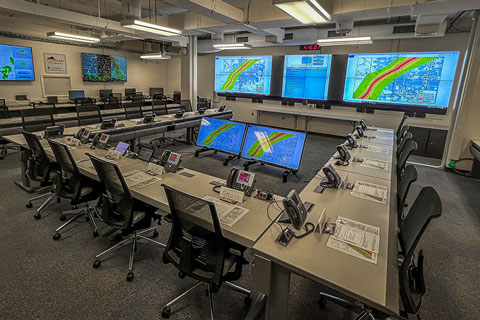
Most Emergency Operations Centers are far more dependent on internet connectivity than they realize.
WebEOC. GIS mapping. Cloud-hosted documents. VoIP systems. Resource tracking. Situation reports. Mutual aid coordination. Nearly every major operational system inside a modern EOC assumes one thing:
The internet will always be available.
But during large-scale disasters, infrastructure failures, cellular congestion, and damaged communications networks can quickly change that reality.
The question is no longer whether connectivity disruptions happen. The question is:
What happens to operations when they do?
At Nexaer LTD, we built NetCrate specifically to help solve that problem.
Modern Emergency Operations Depend on Connectivity
Emergency management has become heavily cloud-dependent. Even agencies with strong continuity plans often discover hidden weaknesses during real-world deployments:
- Web-based coordination platforms become unreachable
- VPN access fails
- Cellular hotspots slow to unusable speeds
- Field teams lose reliable communications
- GIS platforms become inaccessible
- Remote coordination breaks down
- Public communications slow dramatically
- Resource tracking becomes fragmented
In many disasters, communications are not completely offline. They are degraded.
That partial degradation creates major operational problems because systems still appear online while becoming unreliable enough to disrupt response operations.
Traditional Backup Internet Often Fails Too
Many agencies already maintain backup internet providers. The problem is that many providers still rely on overlapping infrastructure:
- Shared fiber routes
- Shared tower infrastructure
- Shared backhaul networks
- Shared power vulnerabilities
- Shared congestion points
A secondary ISP inside the same building does not necessarily create true resiliency.
Real communications resiliency requires:
- Multiple carrier options
- Independent transport paths
- Automatic failover
- Rapid deployment capability
- Battery-backed operation
- Portable field-ready hardware
What Is NetCrate?
NetCrate is a ruggedized deployable communications platform designed to rapidly restore reliable internet access during infrastructure failures, disaster response operations, and remote deployments.
The system supports T-Mobile, Verizon, AT&T, and Starlink satellite connectivity with automatic failover between available connections. If one network becomes congested or unavailable, traffic can continue routing through alternate paths.
NetCrate also provides:
- Dual-network WiFi segmentation
- Separate priority and public access networks
- Battery-backed operation
- Portable deployment
- Minimal setup requirements
- Fast field deployment times
The goal is simple: take the system out of the case, power it on, and establish connectivity quickly without requiring a dedicated IT team.
Connectivity Is Now Critical Infrastructure
Communications is no longer just a support function inside emergency management. Reliable internet access now directly impacts operational effectiveness.
Without connectivity:
- Coordination slows down
- Situational awareness decreases
- Resource management becomes harder
- Cloud-based systems fail
- Interagency coordination weakens
- Public information distribution suffers
Modern response operations increasingly depend on digital systems that require stable connectivity to function properly. That means resilient communications infrastructure needs to be treated with the same level of importance as:
- Power systems
- Radio interoperability
- Fuel logistics
- Physical command infrastructure
The First 72 Hours Matter Most
The first operational period after a disaster is often the most difficult. Infrastructure assessments are incomplete. Communications networks are unstable. Field conditions change rapidly. Resources are moving constantly.
This is also when reliable connectivity becomes most valuable.
Deployable communications systems allow teams to:
- Restore internet access quickly
- Maintain cloud platform access
- Coordinate field personnel
- Support public communications
- Maintain operational continuity while infrastructure is repaired
For many agencies, the objective is not replacing permanent infrastructure. It is maintaining operational capability until permanent systems stabilize.
Final Thoughts
Emergency management continues becoming more connected and more dependent on reliable internet access every year. That creates major operational advantages, but it also creates new vulnerabilities.
The agencies that prepare for those vulnerabilities before disasters occur are often the ones that maintain operational continuity when infrastructure becomes unreliable.
NetCrate was built around that reality. It's a deployable kit built specifically for mobile command center internet and broader deployable communications needs.
Learn more about NetCrate
Portable multi-network connectivity for disaster response and field operations.